
Brainspotting Therapy In Indianapolis
A body-based approach that reaches what talk therapy alone often cannot
Sometimes talk therapy does not reach the places where pain actually lives. You can describe an experience, understand it completely, even talk about it for years, and still feel its grip on your body and your nervous system.
Brainspotting is designed to reach exactly that depth.
At CCA Therapy in Indianapolis, Brainspotting is at the core of how we work. It is a neurobiological approach that accesses where trauma, anxiety, grief, and stress are physically stored in the deep brain, and helps process them at the source.

What Is Brainspotting And Why Do I Use It?
Brainspotting is a powerful therapeutic approach developed in 2003 by Dr. David Grand. It is built on a straightforward discovery: where you look affects how you feel. Specific eye positions, called brainspots, connect to where difficult experiences are held in the subcortical brain, the deep and non-verbal part of the brain where survival responses and emotional memory live.
Unlike talk-based approaches, Brainspotting works beneath the level of conscious thought. It accesses the parts of the brain responsible for trauma responses, emotional regulation, and the body's automatic stress reactions. By holding a relevant eye position while staying aware of what arises in the body, the brain is given the chance to process and release what has been stuck.
This isn’t just talk therapy alone. This goes much deeper than that.
And you don’t have to power through it alone.
How Does Brainspotting Actually Work?
The foundation of Brainspotting is the mind-body connection. Your brain and body are in constant communication, and your nervous system holds the record of everything you have experienced. When something overwhelming happens, the brain sometimes cannot fully process it in the moment. It tucks the experience away, held in the body, where it surfaces later as anxiety, tension, hypervigilance, or emotional reactivity.
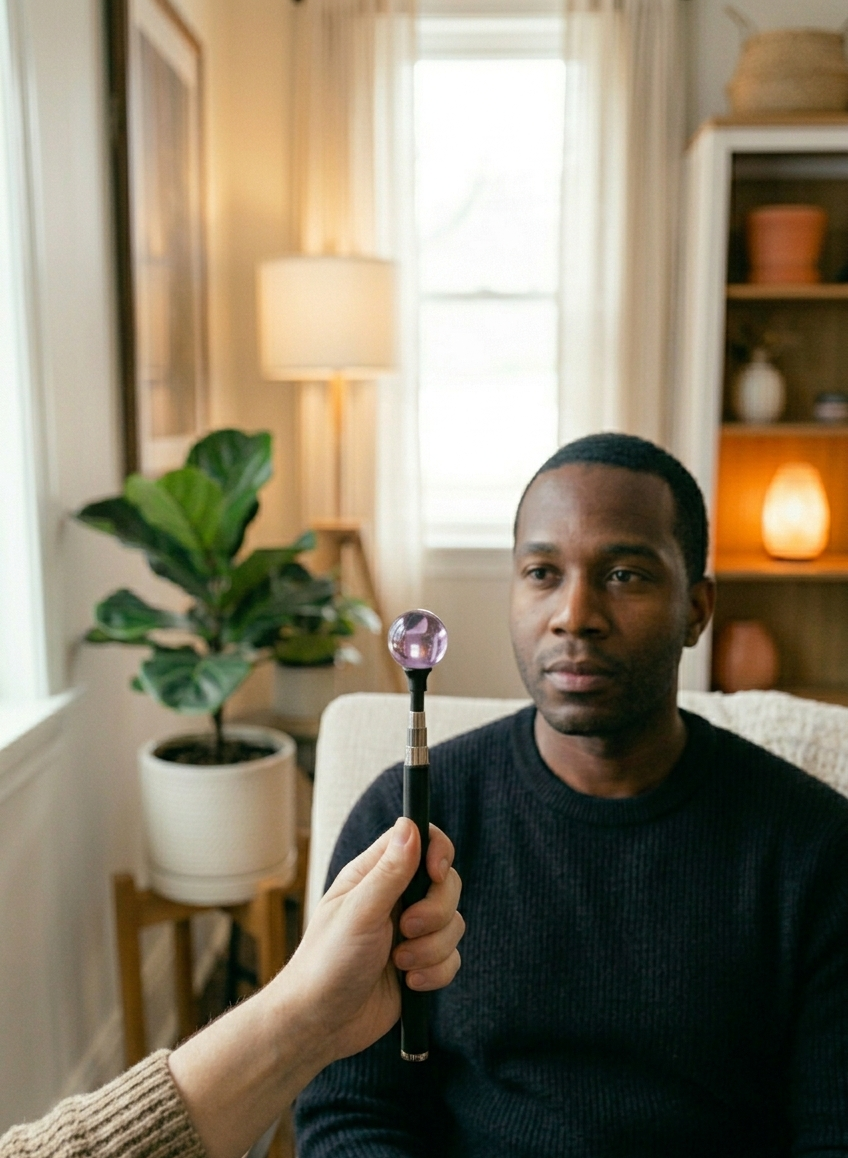
In a session, we start by identifying something you want to work on. An emotion, a memory, a physical sensation, a pattern. We then use a pointer to find the eye position where you feel that issue most intensely. Once we find that spot, you simply notice what comes up. Thoughts, body sensations, memories, or sometimes just a quiet sense of something shifting.
This process engages the subcortical brain rather than the analytical cortex, which is why Brainspotting can reach experiences that words often cannot. Bilateral sound, delivered through headphones, is often used alongside the fixed gaze to support the brain's natural processing rhythm.

What Can Brainspotting In Indianapolis Help With?
Because Brainspotting works directly with the nervous system rather than the thinking mind, it's effective across a wide range of presentations. In our practice, we've used it extensively with:
-
Anxiety & Panic Attacks - for clients whose nervous system is stuck in a constant state of high alert. The focused processing of Brainspotting helps the brain learn, at a biological level, that the threat has passed.
-
Trauma & PTSD — including single-incident trauma, complex developmental trauma, and C-PTSD. Brainspotting reaches the parts of the brain where traumatic memories are stored somatically — the places where traditional talk therapy often hits a wall.
-
Addiction & Substance Use - I've worked extensively with clients where trauma and substance use are intertwined. Brainspotting helps address the underlying nervous system dysregulation that often drives addictive behavior, rather than just managing the symptoms of it.
-
Grief & Loss - grief that has become physically heavy, that lives in the chest and the throat and the body. Brainspotting helps move what words alone can't shift.
-
Veterans & First Responders - populations who have often been conditioned to push through, stay strong, and not ask for help. Brainspotting is particularly powerful for this group because it doesn't require you to verbally recount your experiences in detail. You don't have to tell the story to heal from it.
-
Performance Anxiety - athletes, performers, and professionals who hit mental blocks that practice and willpower alone can't break through.

What Will A Brainspotting Session Actually Feel Like?
Most clients Brainspot with us for 50 minutes and say afterward that it felt like 10. The deep brain processing that happens during a session creates a state of focused absorption that is unlike anything most people have experienced in a typical therapy hour.
Sessions are quieter and more internally focused than traditional talk therapy. There is less explaining and more allowing. Many clients describe a sense of something releasing, sometimes with images or emotions arising, and sometimes with just a quiet sense of something lifting. Extended 100-minute intensive sessions are also available for clients who want to do deeper, more sustained work.
You remain fully conscious and in complete control throughout the entire session. You can stop, speak, or take a break at any point. Nothing happens without your awareness and consent.
Here's what happens most often:
-
Some clients describe watching their deep brain process "like a movie reel" — being taken back to memories they thought they had forgotten, or even repressed. Sometimes positive memories surface too, ones they hadn't thought about in years. Others experience the opposite: their mind goes completely blank. For someone whose thoughts have been racing for as long as they can remember, that silence can feel almost miraculous.
-
Most clients move through "waves" — moments of physical sensation that rise and settle, rise and settle. Chest tightness. A knot in the stomach. Tension across the back. Muscle twitches. These aren't signs that something is wrong. They're signs that something is releasing. I describe it to clients like peeling back layers of an onion: you don't know what's underneath each layer, but once we sit with it, it stops stinging after a few minutes.
-
Most clients will experience visual changes during a session. The room may go white and cloudy. The pointer I use may develop a soft glow or "aura." Some clients have described it looking like a "marshmallow on fire." Others see nothing but the pointer — until they blink and look away. All of this is completely normal, and almost universally, clients describe it as fascinating rather than frightening.
-
The deep brain continues to integrate what surfaced during your session for up to 48 hours afterward — often without you being consciously aware of it. Most clients feel pleasantly tired after a session. I always recommend extra water and some quiet time before diving back into a full schedule.
-
Most clients will Brainspot with me for 50 minutes and tell me afterward it felt like 10. The deep brain processing that happens during a session creates a state of focused absorption that is unlike anything most people have experienced in a typical therapy hour.

How Is Brainspotting Different From EMDR?
If you have been searching for EMDR therapy in Indianapolis, you are already thinking in the right direction. You are looking for something that goes beyond talking. EMDR and Brainspotting share the same roots and the same core insight, that the eyes hold a key to where trauma is stored in the brain.
Here is how they differ. EMDR uses rapid back-and-forth eye movements to stimulate bilateral processing and follows a structured eight-phase protocol. Brainspotting uses a fixed gaze, one specific spot, and stays there, allowing the brain to go deeper rather than broader. EMDR follows a protocol. Brainspotting follows your nervous system.
Neither is better in the abstract. What matters is which one fits you, your history, and how your nervous system works. Many clients find Brainspotting gentler and more internally led, which makes it especially valuable for complex or pre-verbal experiences where there is no single clear memory to target.

Frequently Asked Questions About Brainspotting in Indianapolis
-
Brainspotting is for anyone who feels stuck — in traditional talk therapy, in their healing, or in patterns they can't seem to think their way out of. It's particularly effective for trauma, PTSD, anxiety, grief, addiction, and performance blocks. It's also a powerful option for people who struggle to put their experiences into words, or who find that talking about their trauma leaves them feeling raw and re-activated rather than relieved. If you've done the work and still feel like something is lodged somewhere talk therapy can't reach, Brainspotting was designed for exactly that.
-
We start by identifying something you want to work on — an emotion, a memory, a physical sensation, a pattern. Then I use a pointer to find the eye position where you feel that issue most intensely. Once we find that spot, you simply notice what comes up — thoughts, body sensations, memories, images — while I hold space and track your processing. We often add bilateral music through headphones, which supports the deep brain work. We close every session by grounding and briefly discussing your experience before you leave.
-
See the full comparison in the section above — but the short version is: EMDR moves, Brainspotting stays still. EMDR follows a protocol, Brainspotting follows you. Both are powerful — I chose Brainspotting because of its flexibility, depth, and because I've experienced its effects firsthand.
-
Not at all. You are fully conscious and in complete control throughout the entire session. Many clients describe it as a state of deep, focused mindfulness — like being very "in the zone." You can stop, speak, or take a break at any point. Nothing happens without your awareness and consent.
-
Absolutely — and it works remarkably well via telehealth. Instead of a physical pointer, we use objects in your environment, specialized digital tools, or BioLateral music through headphones to find your eye positions. Some clients actually prefer virtual sessions; others like being in the office. We can figure out what works best for you.
-
There's no universal answer, but Brainspotting tends to move faster than traditional talk therapy. Some clients find meaningful relief from a specific block in 3-5 sessions. Others use it as an ongoing tool across several months to work through complex, layered trauma. What I can tell you is that the feedback I hear most consistently is: "I can't believe how much shifted in so few sessions."
-
Most clients feel pleasantly tired — what I call a "processing hangover." It's a good sign. It means your brain is still integrating what surfaced. You may also feel a sense of emotional lightness, or a quiet that feels unfamiliar but welcome. I recommend drinking extra water, eating something grounding, and giving yourself some low-key time after your appointment rather than scheduling something demanding right after.
Your Nervous System Already Knows How To Heal. Let's Help It Remember.
I spent years not understanding why my body felt the way it did. I saw doctors. I tried medications. I did the work. And it wasn't until I sat in a Brainspotting session myself — and felt something release that I didn't even know I was holding — that I understood what this work could actually do.
That's why I'm a Certified Brainspotting Therapist. That's why I keep my own Brainspotting practice going in my own individual therapy. And that's why, when I sit across from a client who's done everything "right" and still feels stuck, Brainspotting is where I turn.
If you're in Indianapolis — or anywhere in Indiana, Ohio, or Florida — and you're ready to try something that goes deeper than talking, I'd love to show you what this work can do.
Insurance & Fees CCA Therapy is a private pay practice. Superbills are available for potential out-of-network reimbursement. Visit our Billing page for full fee information and a Good Faith Estimate.
Our founder, Ethany Michaud, LCSW, came to Brainspotting through her own healing before ever bringing it to clients. You can read more about that story on our About page.
What We Can Help You With
Click any service to learn more about our approach.

Trauma & PTSD
For adults still carrying past experiences in their body, relationships, and nervous system.
Learn more ›
Brainspotting
A neurobiological approach that reaches where trauma is stored in the brain and body.
Learn more ›
Anxiety
For high-achievers who look fine on the outside and cannot slow down on the inside.
Learn more ›
Depression
Including treatment-resistant depression, postpartum depression, and depression rooted in trauma or grief.
Learn more ›
Grief & Loss
For every kind of loss, including grief in recovery, identity grief, and losses that go unrecognized.
Learn more ›
Addiction & Substance Use
Harm reduction-based, judgment-free support for the full spectrum of addictive patterns.
Learn more ›
Ketamine-Assisted Psychotherapy
For clients who have tried everything and are ready for a different kind of door to open.
Learn more ›
Myofascial Release & Somatic Bodywork
Hands-on nervous system support through Barnes MFR and somatic bodywork. Offered by Chelsey Gilbert, LMT.
Learn more ›